Closing the performance gap between detailed design predictions and realized operational yields is critical to ensure predictability, repeatability, and scalability across growing solar portfolios. PV performance models can be utilized across three distinct stages of a solar asset’s lifetime:
- Project development: detailed design
- Construction: supporting capacity and acceptance testing
- Operations: performance baselines and benchmarking
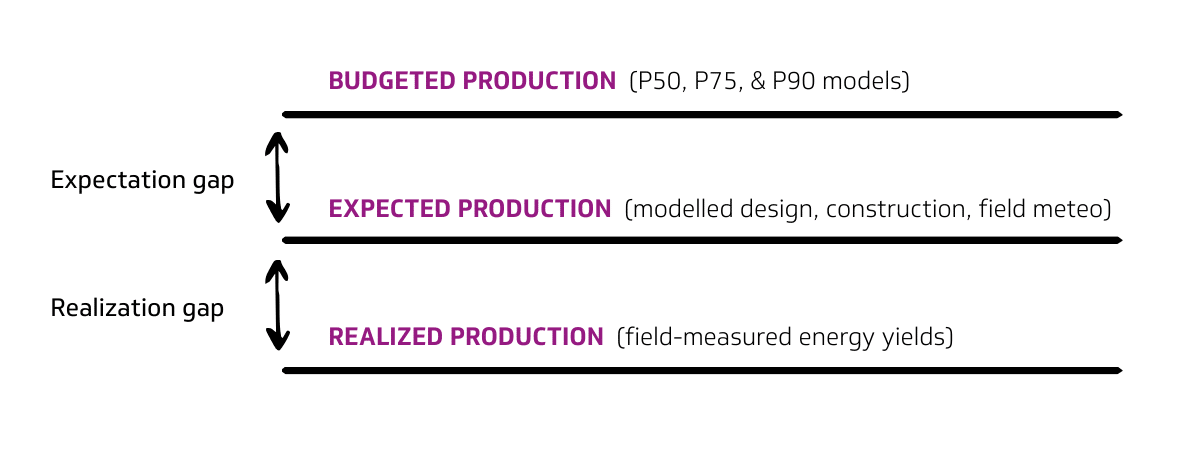
Enurgen bridges the gaps between budgeted, expected, and realized energy yields with a novel 3D finite element method (FEM) modelling approach with advanced loss detection algorithms. This model is leveraged to automate PV performance assessments and addresses the systemic 7-13% P50 underperformance gap.
The Budgeted-to-Expected Performance Gap
Budgeted production numbers set the expectation for energy yields in pre-construction and are typically established through a collaborative process involving 2D view factor (VF) modelling using PVsyst software and input from technical advisors. These tools and experts work together to develop and validate the assumptions underpinning the production estimates, including:
- site-specific irradiance data assumptions,
- shading losses,
- soiling impacts,
- system degradation over time, and
- equipment performance characteristics such as inverter and module efficiencies.
Since this software uses a 2D view factor model for energy yield calculations, the model is inherently limited in its ability to capture real-world complexities such as:
- 3D shading effects of site layout and racking structure,
- diffuse irradiance shading,
- non-uniform illumination on the front and rear,
- electrical mismatch,
- bifacial gain,
- edge brightening, and
- complex terrain.
Other limitations [CV3.1]common in this approach include:
- sub-hourly behavior, including sub-hourly clipping losses,
- lack of physical representation for some site characteristics, and
- empirical derate factors.
Moreover, re-evaluating the assumptions used in budgeted production simulations against expected production models that make use of field meteorological data often reveals discrepancies between these two phases, resulting in a budgeted-to-expected model performance gap.
Enurgen’s Accurate Performance Baseline
Enurgen builds accurate yield predictions starting in pre-construction with its novel 3D engine, DUET (DUal-sided Energy Tracer). DUET calculates front and rear side non-uniform irradiance across each solar cell, generating high spatiotemporal irradiance profiles of cells, panels, and strings. This software eliminates the need for empirical and user-defined input factors, instead relying on physically measured parameters (such as racking size and shape) and known quantities to reduce uncertainty and calculate the effects of terrain, near-shading, and sub-hourly system dynamics.
To calculate expected production, Enurgen’s model dynamically integrates field-measured meteorological data (e.g., irradiance, temperature, and soiling, if available) to produce a physics-based representation of energy generation. Since simulations can be run down to minutely intervals, the model determines the asset’s generating capability at granular time steps for maximized insights.
Unlike 2D models where input factors chosen in pre-construction may need to be iterated and tuned to represent a system over a longer-term aggregation, Enurgen’s expected production model accurately reflects real-world behavior the first time and aligns temporal profiles for every timestamp. Without the need to tune inputs, variations between modelers are reduced. This sub-hourly cell-to-system model serves as an effective performance baseline to compare to realized energy yield production.
Identifying and Isolating Sources of Underperformance
To determine model-to-asset performance deviations, Enurgen’s expected and field measured energy yields are compared at each time step across the plant hierarchy. The model incorporates key physical processes that can cause loss, including sub-hourly irradiance variability, module temperature fluctuations, rear-side irradiance impacts (for bifacial systems), dynamic shading and soiling effects, amongst others.
Once the expected-to-realized yield differences are quantified, Enurgen’s software bridges the gap to realized production by incorporating and quantifying operational losses both spatially and temporally. Availability issues, curtailment events, component underperformance, and others are detailed in the model outputs to enable performance teams to quickly identify and isolate sources of underperformance from the grid injection point down to the combiner box level, enabling fast and proactive resolution and accurate quantification of performance issues.

Enurgen’s core engine and dynamic approach ensures that realized production gaps can be effectively explained, quantified, and addressed, ultimately helping operators optimize performance and align production expectations with actual outcomes.
By bridging both the budgeted-to-expected and expected-to-realized gaps, Enurgen provides a seamless, end-to-end solution for improving solar asset predictability, scalability, and operational efficiency.